“Risk of Addiction Is Steadily Rising Among Working Women”
Mental Health Index Report – November 2020 Update
November marks another month of elevated stress, anxiety, depressed mood, and negativity among American workers.
This month’s Mental Health Index shows that women are finding it difficult to cope with the weight of the pandemic, resulting in both physical and mental exhaustion. As these factors combine, it is creating an unhealthy scenario for those trying to deal with stress, anxiety, and negative feelings brought on by the pandemic. In this update report, we’ll discuss insights including:
Women’s risk of addition has increased 65% from September to November.
Depressed mood is now 40% higher in women than before COVID-19.
Three ways Americans are adapting to COVID-19 related stress and anxiety
Download Now
“RPA improves customer experiences at a top financial services corporation”
Learn how Intelligent Automation can transform your customer service
As one of the world’s fastest payment processing network, this financial services corporation uses technology along with its expertise to make transactions between consumers, merchants and businesses simple and safe.
Download Now
“Diversity, Equity, & Inclusion at Work: Creating programs with tangible value”
The best of Business Management Daily’s advice
At this point, just about everyone is likely familiar with Diversity, Equity, and Inclusion programs. They look good to shareholders, and often “feel like the right thing to do.” But are you, and your employees, really getting the value out of these programs that you intend?
In this special report, we’ve collected the best of Business Management Daily’s advice on how to implement DEI programs, what resources you might need, and best practices you can implement that won’t blow your budget. Whether you’re a small business, Fortunate 500 company, in-person, remote, or hybrid — we’ve got the insight you need.
Download Now
“Economic Downturn: Tech & Trends for Financial Executives”
The Critical Role of Finance as a Service (FaaS) in Today’s Finance and Accounting Marketplace
Big Four FaaS Market Study
New data underscores the critical role that outsourcing plays in the overall finance and accounting market today. The global market for finance and accounting outsourcing — also sometimes referred to as Finance as a Service (FaaS) — in 2020 was estimated at $37.9 billion. This is projected to grow to $53.4 billion by 2026, growing at a CAGR of 5.9% over this time. (globalnewswire.com)
Finance is now the second most outsourced function among corporations, behind IT and ahead of payroll and customer service, with 44% of businesses outsourcing the finance function. (moneytransfers.com)
The global economic crisis is one factor in the increased demand for FaaS. Growing demand for cost savings, digital transformation, more transparency and increased regulations are driving companies to standardize their finance and accounting activities. This move toward standardization is also driving the incorporation of financial management best practices, which is a key factor in the adoption of FaaS.
Download Now
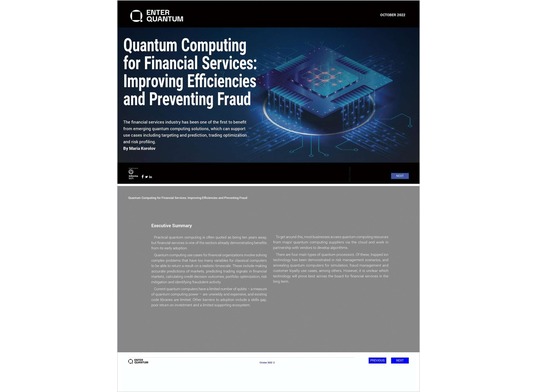
“Quantum Computing for Financial Services: Improving Efficiencies and Preventing Fraud”
Should you be benefiting from emerging quantum computing solutions, which can support use cases including targeting and prediction, trading optimization and risk profiling?
Practical quantum computing is often quoted as being ten years away, but financial services is one of the sectors already demonstrating benefits from its early adoption.
Quantum computing use cases for financial organizations involve solving complex problems that have too many variables for classical computers to be able to return a result on a realistic timescale. These include making accurate predictions of markets, predicting trading signals in financial markets, calculating credit-decision outcomes, portfolio optimization, risk mitigation and identifying fraudulent activity.
Current quantum computers have a limited number of qubits – a measure of quantum computing power – are unwieldy and expensive, and existing code libraries are limited. Other barriers to adoption include a skills gap, poor return on investment and a limited supporting ecosystem.
To get around this, most businesses access quantum computing resources from major quantum computing suppliers via the cloud and work in partnership with vendors to develop algorithms. There are four main types of quantum processors. Of these, trapped ion technology has been demonstrated in risk management scenarios, and annealing quantum computers for simulation, fraud management and customer loyalty use cases, among others. However, it is unclear which technology will prove best across the board for financial services in the long term!
Download Now
“Scaling and Measuring Robotic Process Automation”
The idea of the self-service digital worker pays dividends for businesses undergoing this transformation. Traditional automation essentially shied away from empowering workers, but they are the experts in their respective fields — so why not leverage that knowledge to create better outcomes all around?
For the largest enterprises in technology, increasing value has always been an absolute priority. So how is a company with a 60% compound annual growth rate, a thousand processes to automate, and around 1500 global stakeholders going to achieve this? By scaling.
A business unit may already have implemented RPA. APls might also play a role. But they all must be measured to ensure they create effective business outcomes. And that’s where the second part of the equation comes into play.
Download Now
“Private Equity Funding in Technology: What’s the Impact on the Channel?”
Private equity funding in the tech industry continues apace — but is it a good thing for the channel?
With tech now an intrinsic part of the business landscape, the B2B tech industry is a prime target for investment by private equity (PE) investment. But some have suggested that such investment ignores the value the channel can bring. Is the current spate of investment an opportunity or an added challenge for channel partners?
Should partners be worried about the potential fallout for their businesses? This report will look at both the potential problems and opportunities PE investment might generate for partners. You will learn:
What’s driving private equity investments in tech
How a vendor’s channel partners impact its perceived value
How companies are using private equity investment funds
Download Now
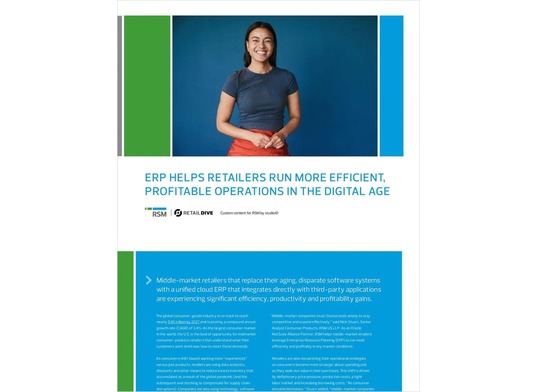
“How Retailers Can Run More Profitably in All Market Conditions”
Explore how retailers can streamline their operations and optimize processes with ERP.
The global consumer-goods industry is on track to reach nearly $40 trillion by 2027 and is posting a compound annual growth rate (CAGR) of 3.8%. As the largest consumer market in the world, the U.S. is the land of opportunity for midmarket consumer-products retailers that understand what their customers want and know how to meet those demands.
This playbook explores how middle-market retailers that replace their aging, disparate software systems with a unified, streamlined cloud ERP can experience significant efficiency, productivity, and profitability gains. It will discuss how blending a cloud-based ERP with deep industry expertise can help retailers:
Operate more efficiently
Gain inventory visibility and make data-oriented decisions
Create more accurate forecasts
Obtain real-time financials with a centralized source of truth
Differentiate themselves in the marketplace
Improve customer satisfaction
Expand reach, increase revenue, and maintain profitability
Download Now
“How to Get Buy in From Stakeholders on Your Next LMS Software Purchase”
Ready to make your case for new software? Download this template to help you get organized and convince stakeholders to support your case for new lms software.
Getting buy-in from stakeholders isn’t always easy, but you have to start somewhere. More importantly, you need to convince all stakeholders that this software purchase project can benefit all stakeholders—at any level
Software Advice has created a handy downloadable stakeholder template. You can use this with your stakeholder’s influence and interest, level of involvement, and pain points, which will help you identify their needs and plan for how to address them.
In addition, one of our expert software advisors will help analyze your unique business needs and set you up with free product demos and price information.
Download Now
“Moving Tax to the Cloud: A Financial Perspective”
Cloud (Saas) technology is known for being a cost-effective solution with quicker implementations, minimal use of hardware, and low maintenance costs.
For your indirect tax function, regardless of whether you use native ERP functionality or an integrated on-premise tax engine to calculate tax, there are both external and internal costs to consider. Total cost of ownership (TCO) is one of the most important factors to evaluate when considering a move to a cloud-based tax solution.
Download this white paper to learn about:
What TCO is comprised of and how to reduce it
Costs when migrating from a native ERP to cloud
Costs when migrating from an on-premise tax engine to the cloud
How to future-proof your tax function to pivot with ease as your business expands